

Organizations preparing for IPOs, funding rounds, or acquisitions face a recurring problem during due diligence: Their governance, risk and compliance systems can't answer basic questions about control effectiveness, regulatory exposure or entity-level compliance status.
The reason is consistent; separate departments operate incompatible platforms that were never designed to provide unified intelligence. Risk assessments sit in one system, compliance monitoring in another, audit findings in a third, entity management in a fourth.
When buyers or investors ask for integrated views of governance maturity, organizations discover their fragmented infrastructure cannot deliver answers without weeks of manual aggregation.
This fragmentation challenge extends far beyond transaction readiness. Most organizations approach integrated governance, risk and compliance (GRC) through disconnected departmental initiatives that create compounding inefficiencies over time.
According to Diligent’s Transaction Readiness report, 60% of organizations report their GRC and finance systems are either completely siloed or only partially integrated, with just 4% achieving full platform integration.
The consequences manifest in predictable ways: unnecessary expenditure on redundant vendor subscriptions, increased operational complexity from incompatible data structures, decreased ability to respond to emerging threats, and greater risk exposure from governance blind spots.
In light of the above, this guide explains how to implement effective GRC, covering:
Integrated GRC is a unified approach to managing governance structures, risk exposure and compliance obligations through coordinated processes, shared data and consolidated technology platforms.
Rather than treating each domain as an isolated concern, integrated GRC recognizes that governance decisions affect risk profiles, compliance obligations create governance requirements, and risk events trigger both governance escalation and regulatory responses.
This means that the governance, risk and compliance capabilities of an organization work together rather than competing for resources and creating contradictory requirements.
Effective integrated GRC connects five essential domains into a unified infrastructure:
When these components operate through shared data models and coordinated workflows, organizations gain comprehensive visibility that siloed approaches cannot provide.
Risk events automatically trigger compliance reviews, audit findings update risk assessments, regulatory changes immediately highlight affected controls, and board reports synthesize insights from all domains into cohesive intelligence.
The current business environment presents unprecedented coordination challenges that fragmented GRC systems cannot address effectively. Multiple simultaneous pressures create a perfect storm requiring unified infrastructure.
According to the Q3 2025 GC Risk Index conducted by Diligent Institute and Corporate Board Member, general counsel, chief compliance officers and audit leaders cite unpredictability of the regulatory environment as a top business risk. Organizations face:
"The convergence of these factors keeps risk levels high and requires businesses to invest more in proactive compliance, risk management, scenario planning and governance frameworks," says Taras Lytovchenko, Chief Legal and Compliance Officer at Trinitex.
Organizations responding to this volatility report increasing emphasis on technology for monitoring and regulatory tracking. However, 43% acknowledge they have not changed compliance priorities at all in response to geopolitical instability — an alarming disconnect given that respondents ranked geopolitical conflicts as the third-most-pressing business risk.
Organizations feel internal pressure to adopt AI technologies while simultaneously needing to govern AI-related risks. The same Q3 2025 GC Risk Index finds:
This creates a dual challenge: Organizations must implement AI for competitive advantage while building governance frameworks to manage AI risks.
Integrated GRC platforms address both needs by providing AI-powered automation while maintaining appropriate oversight and control.
Organizations operating fragmented GRC functions experience predictable inefficiencies that compound over time. Understanding these costs helps build the business case for integration.
When organizations address governance, risk and compliance challenges department by department, they typically invest in separate systems, processes and technologies for each function.
These solutions rarely integrate effectively for cross-organizational purposes. The result: duplications, redundancies and mounting subscription costs as each department adds specialized tools.
When departments solve compliance and risk management challenges independently, they create inconsistent and increasingly complicated operational environments. One team's risk assessment methodology bears no resemblance to another team's approach.
Compliance monitoring in one business unit uses entirely different criteria than identical activities in a different unit. This fragmentation increases the likelihood of human error, control failures and compliance gaps.
When risk identification occurs in one system, compliance monitoring in another and audit testing in a third, no single person can confidently assert that controls adequately address all identified risks.
Organizations that are stretched thin and maintaining poorly coordinated systems struggle to respond to emerging challenges or new opportunities. They fail to identify problems at early stages, allowing them to reach a crisis point before triggering a response.
The data supports this observation. According to the Transaction Readiness Report from Diligent Institute, 56% of organizations cite limited resources as their top transaction readiness challenge.
When these limited resources manage multiple incompatible GRC systems, they have even less capacity for proactive planning or strategic initiatives.
The siloed approach narrows organizational focus to the most pressing emergencies. This day-to-day crisis mode leaves no time for strategic safeguards or comprehensive oversight. Organizations remain vulnerable to unexpected changes or shifts in policy that their fragmented monitoring systems failed to identify.
Without integrated visibility, organizations cannot confidently answer basic questions:
Fragmented GRC systems create board reporting problems that extend beyond operational inefficiency. When directors receive separate reports from compliance, risk, audit and legal functions — each using different terminologies, timeframes and metrics — they cannot synthesize information into coherent strategic intelligence.
"Tell the board what they need to know, not what you know," says David Platt, Chief Strategic Development Officer and Member, Executive Leadership Team at Moody's. This principle recognizes that boards need synthesized insights, not raw data from multiple incompatible systems.
Organizations with siloed GRC also miss strategic opportunities to use governance infrastructure as a competitive advantage.
Break down silos with AI-powered platforms that connect board governance, enterprise risk, audit and compliance into seamless workflows.

Organizations that successfully implement integrated GRC establish specific capabilities that deliver cohesive intelligence while managing complexity. These elements work together to create infrastructure that scales with organizational growth.
Successful integrated GRC solutions provide a bird's-eye view of entire risk landscapes paired with the ability to examine specific problem areas, control weaknesses or compliance gaps in detail.
Executives can quickly understand the status of issues, events and unresolved findings, then hold individuals accountable for implementing solutions.
This visibility extends across organizational boundaries:
Coordinated GRC initiatives eliminate redundant audits and assessments that require multiple parallel searches for identical information. Instead, information-sharing allows data collected once to inform decisions across the organization.
Organizations leveraging integrated platforms report substantial efficiency gains. According to case study data, Telepass achieved 50% faster action follow-up after implementing a unified GRC infrastructure. "Now we have comprehensive, single, unique reporting available to the board," confirms Michele Variale, Chief Audit Executive at Telepass.
Organizations benefit from consistent GRC practices that operate uniformly throughout the company. Standardized methodologies and reporting frameworks allow analysts to compare data and extract insights across business units, geographies and time periods.
Integrated platforms establish this consistency through shared data models, common workflows and unified reporting templates. Organizations can confidently:
Any organization investing in an integrated GRC infrastructure needs confidence that implementation will endure through growth, acquisitions and regulatory evolution. Solutions must accommodate increasing complexity without requiring complete reimplementation.
Scalability manifests in several dimensions:
Organizations with a scalable, integrated GRC infrastructure adapt to change rather than rebuilding governance systems for each new challenge.
In an environment where legal and compliance leaders rate business risk at 7.9 out of 10, security management cannot remain an afterthought.
Integrated GRC programs provide security monitoring, threat modeling and access controls that protect sensitive governance information while enabling appropriate collaboration. Effective platforms implement:
Organizations managing confidential board materials, sensitive risk assessments and proprietary compliance strategies require security infrastructure that scales with their integrated GRC ambitions.
Building comprehensive, integrated GRC systems requires unified technology that connects governance, risk, compliance and audit activities into seamless workflows.
Organizations need solutions that eliminate information silos while providing role-specific intelligence for different stakeholders across the enterprise. With the above in mind, Diligent offers the following:
The Diligent One Platform centralizes board collaboration, risk management, compliance tracking and audit coordination into a unified solution that scales from mid-market to enterprise complexity. The platform provides real-time visibility into GRC performance across all organizational levels and geographic locations.
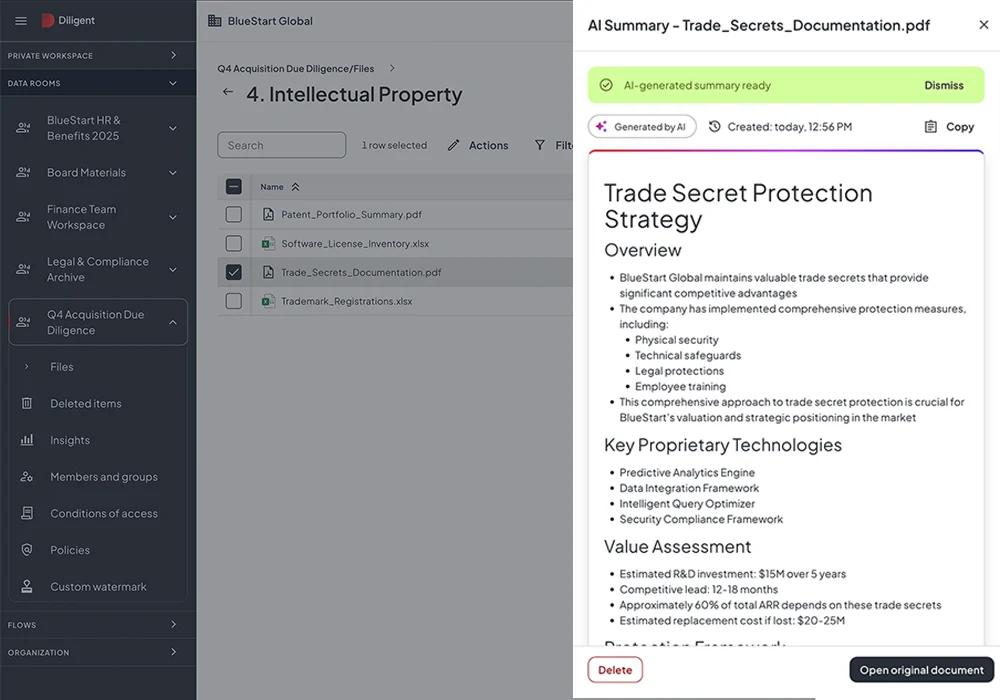
Key capabilities include secure board portals for confidential governance discussions, automated compliance monitoring, comprehensive risk dashboards, and integrated audit management.
The platform's 100+ third-party integrations enable seamless data flow from existing systems (Salesforce, SAP, Oracle, Microsoft) into a unified GRC infrastructure.
Rather than replacing functional systems, Diligent One orchestrates information from disparate sources into cohesive intelligence that supports strategic decision-making.
Building on the unified platform foundation, Diligent Enterprise Risk Management enables organizations to strategically manage risk by rapidly identifying, prioritizing and responding to risks wherever they originate.
The platform provides complete visibility into enterprise risk posture with built-in dashboards and customizable reporting that empower executives to make confident, data-driven decisions.
Rather than reactive responses to individual risk events, the platform's AI-powered analytics correlate risks across departments, enabling organizations to understand interconnected threats and respond comprehensively.
For lean teams launching risk management programs, Diligent’s AI Risk Essentials delivers sophisticated risk capabilities through an accessible interface.
Built specifically for resource-constrained organizations, the solution provides advanced risk analytics, automated scenario modeling and comprehensive risk libraries that accelerate assessment and monitoring without requiring extensive risk management expertise.
Together, these solutions provide the integrated platform capabilities that mid-market and enterprise organizations need to mature from reactive GRC to proactive, intelligence-driven oversight.
Ready to transform your GRC infrastructure from fragmented point solutions to integrated intelligence? Schedule a demo to discover how Diligent delivers the unified platform capabilities that drive governance excellence and competitive advantage.
GRC refers broadly to organizational approaches for managing governance, risk and compliance. Organizations can practice GRC through disconnected departmental activities — compliance in one silo, risk in another, governance in a third.
Integrated GRC specifically means these functions operate through coordinated processes, shared data and unified technology platforms.
The integration provides comprehensive visibility, eliminates redundant effort and enables strategic synthesis that siloed approaches cannot achieve.
Organizations measure integrated GRC ROI through several dimensions:
Organizations encounter several common implementation challenges:
Ready to transform fragmented GRC systems into unified intelligence that drives strategic value? Request a Diligent demo today.





