

Fraud schemes are outpacing traditional detection methods. While finance teams implement dual approvals and segregation of duties, fraudsters exploit gaps between departments with business email compromise, synthetic identities and insider collusion that bypass standard controls.
The question boards now face is whether their organizations can detect and respond before schemes cause irreversible damage.
Evidence suggests many organizations aren't prepared. Legal and compliance leaders rate the current business risk environment at 7.9 out of 10, a 36% increase from early 2025, while 41% of board directors identify ethics and culture-related scandals as having a significant impact on corporate strategy.
These concerns are valid, as material risks affect valuations, particularly for growth-stage companies preparing for transactions or public offerings.
Systematic fraud risk management addresses this gap by moving beyond reactive detection to integrated frameworks spanning finance, compliance, audit and operations. Rather than fragmented controls managed in silos, enterprise fraud risk management treats fraud as an organizational risk requiring coordinated prevention, detection and response capabilities.
This article explains how to build and optimize enterprise fraud risk management programs, covering the following:
Enterprise fraud risk management is a systematic approach to identifying, assessing, preventing and responding to fraud risks across an organization.
Unlike basic fraud prevention, which typically focuses on individual control points like segregation of duties or approval hierarchies, enterprise fraud risk management treats fraud as an organizational risk that requires coordinated frameworks spanning multiple business units, geographies and functions.
Traditional fraud prevention operates tactically, implementing controls at transaction or process levels. An accounts payable team might require dual approval for payments over certain thresholds, or HR might conduct background checks on new hires. These controls are valuable, but fragmented.
Enterprise fraud risk management takes a strategic view. It connects financial crime risks with operational controls, cybersecurity threats and compliance requirements into a unified framework that boards can oversee effectively. This means:
Effective fraud risk management requires several interconnected components that work together to prevent, detect and respond to fraud threats.
Clear governance establishes accountability and ensures appropriate resources support fraud risk management. This includes:
Strong governance also means appointing a designated fraud risk management leader, often the chief risk officer, chief audit executive or chief compliance officer, with direct board access and authority to coordinate across business units.
Risk assessment forms the foundation of any fraud risk management program. Organizations must identify and evaluate fraud risks specific to their operations, considering industry, geography, business model and organizational culture.
"There needs to be collaboration between risk and the business, vertically up and down but then also horizontally across the organization," says Michael Rasmussen, CEO of GRC Report. "Risk and audit are interconnected and interdependent. Collaboration helps provide audit's perspective, their insight across company policies and procedures that help improve risk's function."
Effective risk assessments examine both inherent fraud risks (vulnerabilities that exist regardless of controls) and residual risks (remaining after considering existing controls).
This analysis should cover all fraud typologies relevant to the organization and consider how risks might evolve as the business changes.
Controls form the operational layer of fraud risk management. Preventive controls aim to stop fraud before it occurs through measures like segregation of duties, authorization requirements, physical security and vendor due diligence.
Detective controls identify fraud that occurs despite preventive measures. These include transaction monitoring, exception reporting, data analytics and whistleblower hotlines. The most sophisticated programs use continuous monitoring that analyzes 100% of transactions rather than samples.
When fraud occurs or is suspected, organizations need established investigation protocols. This includes secure evidence preservation, qualified investigators (internal or external), consistent interview procedures and appropriate involvement of legal counsel.
Response capabilities also encompass remediation planning — how the organization will recover losses, strengthen compromised controls and prevent recurrence. Clear escalation protocols ensure serious incidents receive appropriate board notification.
Fraud risk management programs require ongoing evaluation and refinement. This includes:
Monitoring also extends to external intelligence, tracking emerging fraud schemes, regulatory expectations and industry incidents that might signal risks to your organization.
Systematic fraud risk management delivers measurable value beyond loss prevention. Organizations with mature programs realize several strategic benefits.
Direct fraud losses represent only part of the financial impact. Fraud incidents trigger investigation costs, legal fees, remediation expenses and operational disruptions. Systematic fraud risk management reduces both the likelihood and magnitude of these costs.
Organizations also avoid the indirect costs that follow fraud: increased insurance premiums, higher audit fees and the opportunity costs of management time diverted from strategic priorities.
Regulators increasingly expect organizations to demonstrate proactive fraud risk management. Sarbanes-Oxley (SOX) Section 404 requires public companies to maintain effective internal controls, which include fraud prevention capabilities. The FCPA mandates adequate anti-corruption programs for organizations with international operations.
"There should be a direct, consistent line of communication from the chief compliance officer or general counsel to the board," says Pav Gill, CEO of Confide. "A strong GC understands that their ultimate responsibility is to the board."
Organizations with documented fraud risk management programs face lower penalties when fraud occurs because they can demonstrate good-faith compliance efforts. This "effective compliance program" defense can significantly reduce both civil and criminal penalties.
For growth-stage companies preparing for funding rounds, transactions or IPOs, fraud risk management capabilities directly affect valuation. Investors and acquirers conduct extensive due diligence on control environments, and weaknesses in fraud prevention create either deal obstacles or valuation discounts.
Public companies benefit from maintaining investor confidence. Material weaknesses in internal controls trigger stock price declines, and fraud incidents can erase years of value creation. Robust fraud risk management protects shareholder value by preventing these scenarios.
Organizations known for strong ethics and effective fraud prevention attract better talent, strengthen customer relationships and maintain supplier confidence. Conversely, fraud incidents damage reputation in ways that persist long after financial remediation.
"The root of the problem here is often cultural, and it's no secret that lack of compliance can kill a business," says Anastassia Lauterbach, PhD. "It's up to the executive leadership team to find the right balance for how much compliance is involved in day-to-day operations."
Culture-building extends beyond policies to lived experience. When employees observe that fraud risks receive serious attention, that incidents trigger thorough investigation and that whistleblowers receive protection, the organization reinforces ethical behavior through action rather than just rhetoric.
See how enterprise organizations unify fraud detection, investigation and reporting across finance, legal, compliance and audit in a single integrated platform.

Organizations seeking to build or mature their fraud risk management capabilities should focus on several evidence-based practices that enhance program effectiveness.
Boards should receive fraud risk reporting at least quarterly, covering risk assessment updates, control effectiveness metrics, investigation summaries and emerging threats. This reporting should be concise but comprehensive — boards need enough detail to fulfill oversight responsibilities without operational minutiae.
"Board members frequently receive surface-level data, such as the number of whistleblowing reports, with little context," says Gill. "Always dig deeper. For instance, three reports in a quarter may sound like a low figure, but if all those reports involve the same individual, that's a red flag worth investigating."
Effective board reporting includes risk heat maps that visualize the fraud risk landscape, key performance indicators tracking program effectiveness, trend analysis showing how the risk profile is evolving and action plans for significant control gaps or incidents.
Annual fraud risk assessments should involve stakeholders across the organization, not just risk and compliance teams. Include finance, operations, sales, procurement, IT and HR in assessment workshops that examine fraud risks from multiple perspectives.
Risk assessments should consider both quantitative factors (historical loss data, transaction volumes, control testing results) and qualitative factors (organizational culture, incentive structures, competitive pressures). The assessment process itself builds fraud awareness across management teams.
Traditional sampling-based testing reviews only a fraction of transactions. Data analytics enable continuous monitoring that examines 100% of transactions for fraud indicators. This shift from periodic testing to real-time monitoring significantly improves both fraud detection speed and deterrence.
Analytics should focus on anomaly detection — identifying transactions or patterns that deviate from normal baselines. This includes duplicate payments, unusual vendor relationships, off-hours activity, segregation of duties violations and behavioral anomalies that might indicate insider threats.
Most fraud schemes are initially detected through tips rather than controls or audits. Organizations need reporting mechanisms that employees, vendors and customers trust and can access easily.
Effective whistleblower programs offer multiple reporting channels (phone, web, mobile), support anonymous reporting, provide feedback to reporters about investigation status and have explicit non-retaliation policies with consequences for violations.
Fraud risks shouldn't exist in a separate silo from other enterprise risks. Organizations achieve better results by integrating fraud risk assessment into their broader ERM frameworks, ensuring that fraud considerations inform strategic decisions, capital allocation and business model changes.
This integration also improves efficiency by eliminating duplicate risk assessments and creating unified risk reporting that shows boards how fraud risks interact with operational, financial, strategic and compliance risks.
When fraud occurs or is suspected, conduct thorough post-incident analysis beyond the investigation itself.
This includes examining how the scheme succeeded despite existing controls, identifying warning signs that were missed and assessing whether similar vulnerabilities exist elsewhere in the organization.
AI-powered platforms address the scale and complexity challenges that have historically limited fraud risk management effectiveness.
For organizations managing fraud risks across multiple business units, geographies and operational areas, these capabilities enable comprehensive oversight that manual processes cannot match.
Diligent ERM provides centralized fraud risk management with AI-powered identification that benchmarks against 180,000+ real-world risks from public company disclosures. This allows organizations to identify fraud risks relevant to their industry and operations without extensive manual research.
The platform's integration with Moody's risk benchmarking data delivers external intelligence on credit sentiment, financial stability and emerging fraud trends. This external perspective supplements internal assessments, helping organizations anticipate risks before they materialize.
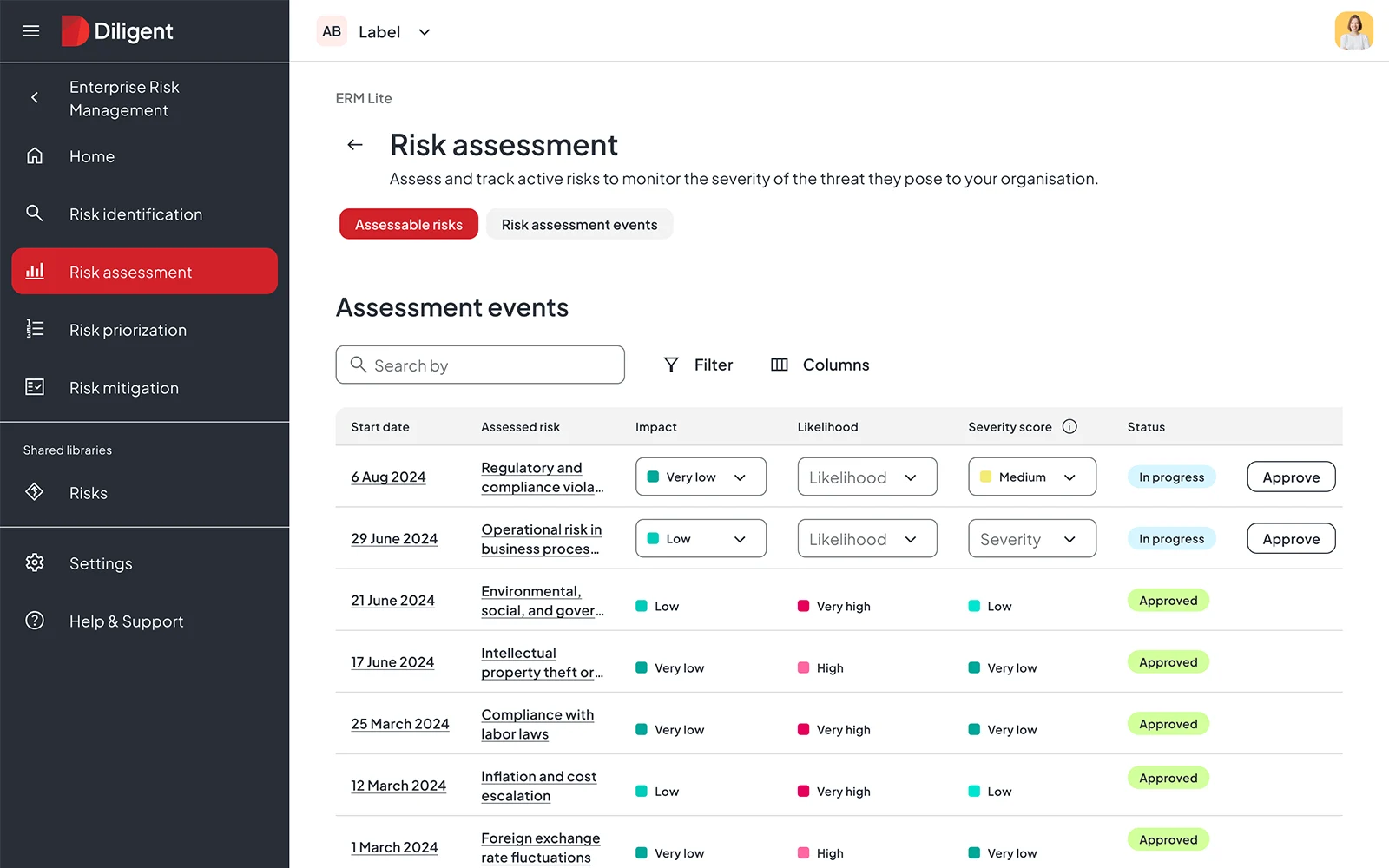
Creating environments where employees feel safe reporting concerns requires both technology and culture. Diligent's Speak Up Manager provides secure, anonymous reporting channels that employees trust, while Resolution Hub centralizes investigation management across legal, compliance, HR and audit teams.
The platform's AI-powered intake routes reports to appropriate teams automatically, accelerating response time while maintaining confidentiality. GoTogether® collective reporting features enable multiple individuals to report the same concern, providing corroborating evidence that strengthens investigations.
In all, the shift from fragmented, reactive fraud detection to unified, proactive risk management requires platforms built specifically for enterprise complexity. Organizations that make this transition strengthen controls while reducing the administrative burden that typically accompanies fraud risk management maturity.
See how unified fraud risk management transforms board oversight and operational efficiency. Request a demo to explore capabilities designed for enterprise-scale fraud prevention.
Public companies face SOX requirements for internal controls over financial reporting, which include fraud prevention capabilities.
Organizations with international operations must comply with the FCPA for anti-corruption programs. Industry-specific regulations may impose additional requirements — for example, financial institutions face BSA/AML obligations, and healthcare organizations must prevent healthcare fraud under federal law.
Most organizations conduct comprehensive fraud risk assessments annually, with quarterly or semi-annual updates focusing on significant changes in operations, markets or risks.
Major business events like acquisitions, new market entry, leadership changes or fraud incidents should trigger interim assessments. Continuous monitoring supplements periodic assessments by providing real-time visibility into changing risk indicators.
Key metrics include:
Trend analysis proves more valuable than point-in-time metrics — boards should examine whether the risk profile is improving, stable or deteriorating.
Ready to strengthen your fraud risk management capabilities? Schedule a demo to discover how Diligent provides the visibility and control your organization needs.





