Board meeting documents are the official materials, which include agendas, financial reports, resolutions and supporting records — that a corporate secretary or governance lead compiles and distributes to directors ahead of each meeting so they have time to review and prepare. Board documents drive the critical decisions board members will make. Too much information risks overloading board members' precious time and resources, while too little risks withholding information necessary to make the calls that keep a firm on track.
Board meeting materials typically include agendas, minutes, resolutions, bylaws, annual reports, financial reports, committee reports and major correspondence.
This guide covers:
- What counts as a board document and what belongs in a board pack
- Common challenges organizations face preparing board materials
- Best practices for sharing board documents securely and on time
- The role board document software plays in modern boardrooms
- How Diligent Boards supports board document management with AI
- Answers to common questions about board documents and minutes
What is a board document?
A board document is any official paperwork or records the board of directors creates, distributes and uses. Board documents include meeting agendas and formal correspondence. They also include other records that keep board members informed about key issues and document decisions. These records maintain transparency within an organization.
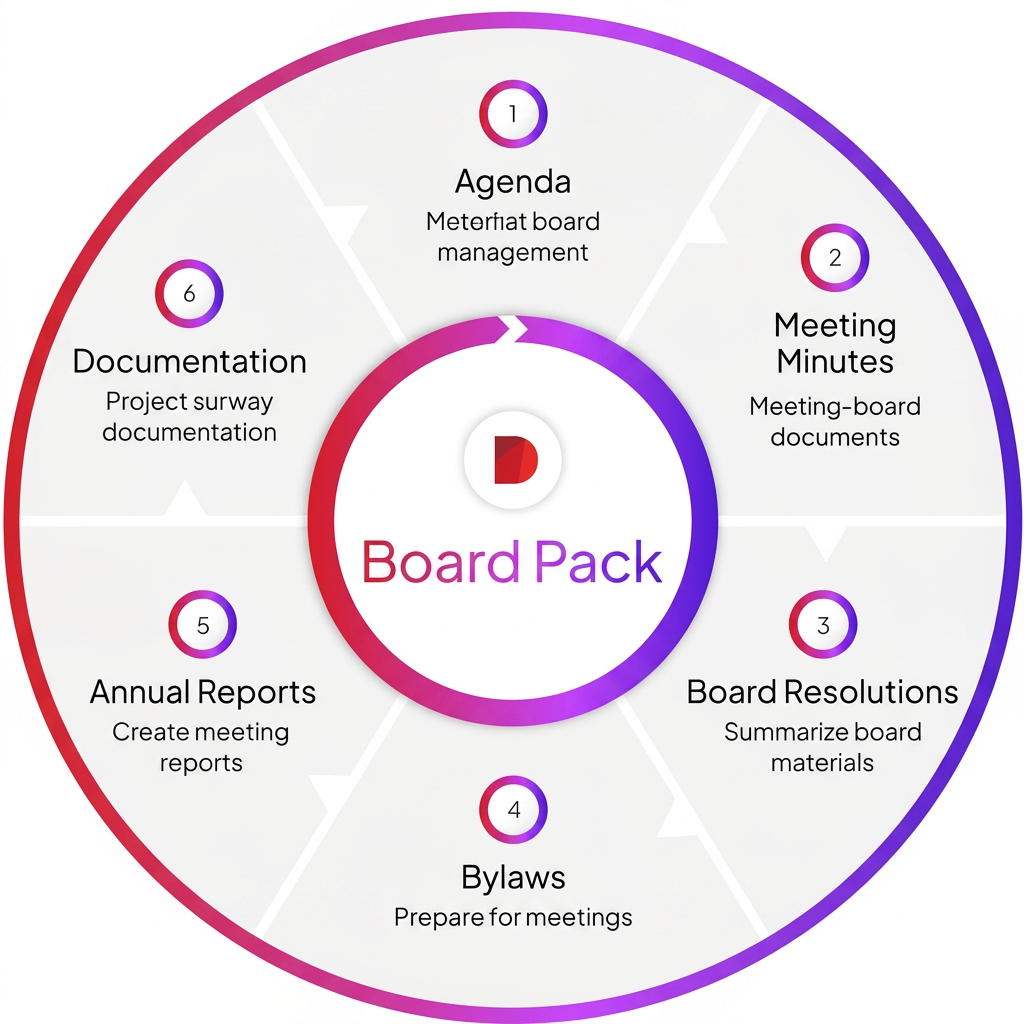
The bulk of the board documents are compiled into a board pack. Board members use the board pack before and during a board meeting. Board packs generally include these documents:
- Agenda. The agenda provides an overview of what will be discussed at the board meeting. Agendas should confirm the purpose of the meeting and outline specific topics for discussion. They should also review previous agendas to address any necessary follow-up. Agendas should be sent to board directors at least two weeks before the meeting. Board directors are busy, and sharing the agenda in advance helps ensure they have time to review it for the upcoming meeting.
- Previous board meeting minutes. Review what was discussed in previous meetings and the current outcome or status. Our article, 'How to take effective meeting minutes (with templates)', offers insight into making the most of your minutes and maximizing meeting productivity.
- Board resolutions. A board resolution is a formal decision or action the board approves. Boards may need to refer back to them in the future or use them to defend various decisions. Including board resolutions in board documents is necessary to keeping both easy to access and secure.
- Bylaws. This board document outlines the governance structure, rules and procedures of the organization. Having it on hand ensures all board activities comply with the bylaws.
- Annual reports. An annual report summarizes the organization's activities and financial performance over the past year. The board may need to reference annual reports to compare performance with the current year, refresh themselves on previous achievements or set new data-based targets.
- Documentation. Documentation guides board discussion and decision-making. Documentation can include:
- Company strategy
- Performance information via financial, human resources and management reports
- Approved budgets
- Committee reports
- Status of action items
- Program highlights for the year to date
- Board roles and responsibilities
- Copy of the organization's bylaws
- Human resources updates
For nonprofit boards, any documents pertaining to fundraising activities should be included.
- CEO (or equivalent) risk/compliance report. This report, created by the CEO, presents risks that may impact an organization's strategy or the viability of its business model. The CEO's team should research and make the report weeks, possibly months, before a board meeting.
- Financial reports. Financial reports help board members make informed, thoughtful decisions on the company's direction. Financial reports typically include:
- A statement of financial position
- A statement of activities
- Cash flow forecast
- Actual results compared to budget
- Operational figures
- The CFO and senior management from Finance are responsible for generating this report and should provide the materials promptly for inclusion in the board pack.
- Committee reports. Corporate board committee reports will likely be more technical, with detailed financial reports, strategy reports, research on a product or service, or analysis. These reports should also be included in the board packs. Nonprofit committee reports focus more on fundraising or community involvement.
- Major correspondence. In many organizations, an investment relations officer (IRO), who reports to the board, is the main point of contact between shareholders and board directors. The IRO usually handles inquiries from shareholders and investors. This information, which can raise critical issues, should be addressed at board meetings.
Common challenges of preparing board of directors documents
The scale of the problem is easy to underestimate: the average board pack now runs to roughly 226 pages, and 54% of board members say they struggle to find the key messages buried inside their materials, according to the Chartered Governance Institute and Board Intelligence. Preparing board of directors documents is often a complex task. Diligent Institute's GC Risk Index 2026 found that only 21% of senior legal leaders are very confident their board receives the right mix of information on risk, which shows why board materials need to be concise and board-ready, with clear priorities. The same pressure shows up at the board level: What Directors Think 2026 found that 58% of directors want more time devoted to strategic planning and 42% want fewer presentations and more discussion at board meetings — both point back to board materials that take too long to work through rather than support the conversation directors actually want to have.
Organizations often struggle with:
- Balancing information and clarity. A common mistake is including too much data in board meeting documents; directors may feel overwhelmed with all the documents needing review. Only include the necessary and time-sensitive documents that are most relevant to the board.
- Ensuring accuracy. Above all, board documents must be accurate. This is especially necessary for financial reports, legal issues, decisions made in previous meetings and any material subject to regulatory requirements. Keeping information accurate across documents and versions can pose a significant challenge.
- Maintaining consistency. Boards often need multiple versions of the same document, such as multiple copies of meeting minutes or years of annual reports. Consistent formatting and terminology help avoid confusion. Consistent structure also helps, but ensuring quality across a high volume of materials is difficult.
- Security. Board documents contain highly sensitive information, including financial data and personnel decisions. Using secure communication channels and encrypted storage is optimal, but many boards communicate over text and email. This can compromise data.
- Timeliness. Another mistake is distributing the materials too late, which doesn't give the board of directors time to review the documents.
Sharing board documents
How far in advance should you send the documents to board directors? The World Economic Forum suggests, "Try to ensure board members get their papers at least a week in advance. If there's a deadline, meet it with several days to spare in case there is feedback before it goes to the board."
Timely document sharing often comes down to the tools organizations use. Organizations have shifted to virtual tools amid more widespread digital transformation, but several other options are still used frequently:
- Email: Many organizations still share board documents by email because it is familiar and simple. While prone to breaches, email remains in use because it is familiar and simple. Email is also easy for less technologically inclined board members and allows organizations to send and receive messages almost instantly. The risk is real at the top of the organization, too — half of directors and C-suite executives still use personal email to communicate sensitive board matters, according to internal Diligent Messenger usage data.
- File-sharing services. Cloud-based file-sharing services allow users to upload documents to a shared folder, which board members can access through a link. More secure than emails, secretaries can create links only directors can access to reduce the risk that board data will fall into bad hands. That said, file-sharing security doesn't always rise to board-level governance.
- Physical distribution. Printed board books were once widely used for board document sharing. Corporate secretaries can still print and mail board packets, which can be easier for some board members to review. While avoiding technology can appeal to less savvy board members, it also introduces significant administrative and supplies costs.
- Board documents software. Secure, cloud-based board document software is increasingly used for board document sharing. Board document software centralizes all board documents and communication in an encrypted governance platform. It supports simpler document creation and distribution.
The role of board document software in modern board rooms
Board document software changes how modern boardrooms operate. Traditional paper-based processes have given way to paperless board documents, which improve the boards' ability to access secure, accurate and mission-critical information.
The shift to centralized board documents also helps meet legal and compliance requirements and makes boardrooms more agile. Boards that adopt board document software gain:
- Efficiency. Board document software eliminates the need for printed materials and makes board documents more sustainable and less costly to produce. Paperless board documents also offer directors instant access to up-to-date insights, which supports better decisions.
- Centralized access to documents. Board document software stores all material, including meeting minutes and financial reports, in a single, secure location. Board members can access documents from any device, anywhere. They always have accurate information at their fingertips.
- Stronger security. Board document software is a significant step up from emails and file sharing. Through encryption and access controls, software safeguards sensitive information. Security-focused board document software reduces the risk of data breaches, unauthorized access, and loss of client-attorney privilege.
- Real-time updates and version control. Paper board documents take hours to produce and can become outdated when board meeting materials change. Digital documents, however, can be updated instantly, with versioning that makes it easier for boards to see only the latest materials. This reduces confusion over which documents to reference.
- Improved compliance and governance. Laws and regulatory requirements set standards for how the board must store and engage with board documents. Board document software securely archives records and offers easy retrieval for audits. This simplifies board governance and helps the board stay audit-ready.
Key features of board document software
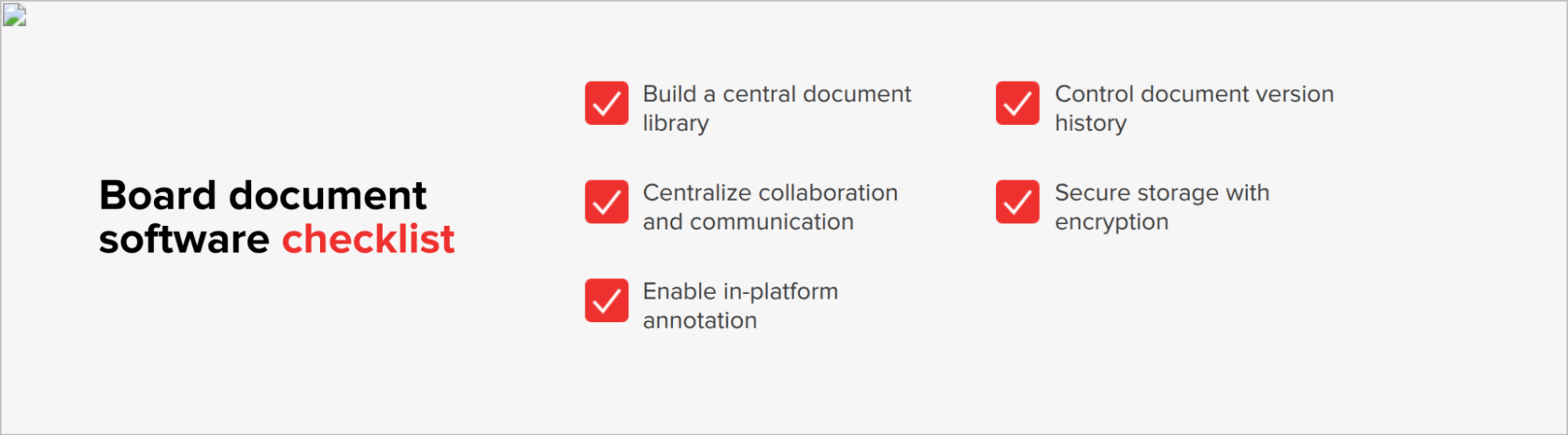
Though board document software can simplify how boards use key documents, features matter. Board document software only helps if it can reduce the steps in time-consuming or inconvenient processes. Look for document management features like:
- A document library. Building your document library means files will always be where you left them. Others will have access to the same library you do. This makes it easier for board members and other leaders to retrieve documents as needed.
- Centralization. Board document software should centralize your documents, collaboration and communication. The more boards can do in one place, the easier it is to track activity and share with the broader board as needed.
- Document collaboration tools. Board document software can allow for in-platform annotation and commenting. This can include integrations with leading tools like Google Workspace and Microsoft 365 to meet collaborators in their own tools.
- Version control. Editing documents without software can make identifying which document is the latest version difficult, especially if multiple board members are involved. Board document software can maintain different versions and automatically identify which is up to date, so all collaborators stay on the same page.
- Secure storage. Board document software, especially software with end-to-end encryption, can protect board documents better than email or paper versions. This maintains a high level of security so sensitive information doesn't fall into the wrong hands.
Future trends in board document software
Recent digital transformation has accelerated the pace of change in most boardrooms, and board documents are no exception. New technology and internal and external pressures will likely affect board document software in several ways. For instance, Artificial intelligence is changing how board members interact with documents. AI-powered tools can quickly analyze large volumes of data, flag key insights, summarize reports and even recommend actions. Assore Holdings saved up to 60% of board meeting preparation time using Diligent Boards AI features, including Smart Builder, SmartPrep 360 and Smart Risk Scanner.
AI adoption is outpacing AI governance
Adoption is moving faster than oversight. What Directors Think 2026 found that 66% of directors now use AI for board work, but only 22% have formal governance processes in place to manage that use — and separately, 40% of directors want access to AI-powered technology for board work and oversight to improve governance effectiveness.
"In our research, we're seeing a sense of cautious optimism from corporate secretaries and general counsel for using GenAI in their work. They see the benefits of having more efficient processes, but are concerned about the potential for inaccurate results. The good news is that there are purpose-built GenAI tools for governance professionals that help to greatly reduce both of these risks," says Dottie Schindlinger, Executive Director, Diligent Institute. Closing that gap starts with human review of AI-generated materials, clearly approved use cases and confidentiality controls around board-sensitive documents, along with director training so the board understands both the value and the limits of the tools it's using.
Make smarter decisions with AI
Ready to enhance your governance, risk, and compliance processes with AI? Experience streamlined workflows and secure data.
Some more trends to explore include the following:
- Governance automation. More boards are reducing manual governance work through workflow automation, including document approval workflows and compliance tracking. This saves time and reduces human error.
- Stronger cybersecurity for sensitive data. Boards handle highly sensitive data, so cybersecurity is a priority. Board document software will incorporate more advanced encryption methods and multi-factor authentication now and in the future. Secure file-sharing capabilities will also continue to matter.
- Cloud-based collaboration tools. As more boards work remotely or with distributed teams, cloud-based software is becoming increasingly essential. This software allows board members to collaborate in real-time on documents, share updates instantly and access materials from anywhere. This improves flexibility and collaboration.
Making the digital switch for better board documents
Compiling a massive number of documents and shipping them to board directors is the traditional method of distributing paper board packs. Some board packs may be distributed via email. What happens if a last-minute document or change is needed? How are boards of directors to maintain version control? Digital board portals can help simplify communication, maintain version control with the most updated materials, reduce mailing and printing costs, collate information, and ease staff's time and work burden. While software can change document management, not all board document software is made equal.
The hesitation is common, and so is what happens once boards get past it. "It took [the board] a few months to watch everyone else using the iPad-based solution before they were ready to adopt Diligent Boards themselves. They never asked for paper again," says Henk Snijders, Deputy Company Secretary, Aegon.
How Diligent Boards supports board document management
Version control, last-minute changes and distribution overhead are the recurring themes in every challenge documented above — and they're exactly what Diligent Boards is built to address. Smart Builder synthesizes raw materials into a professional, board-ready pack automatically, cutting the manual assembly work that eats into preparation time. Smart Risk Scanner reviews board materials before publication to flag risky language and legal red flags, addressing the accuracy and security concerns organizations struggle with most. SmartPrep 360 generates pointed discussion questions for directors ahead of the meeting, helping them arrive prepared rather than reading cold. Smart Summary distills long board packs into actionable director briefings, directly answering the 54% of board members who say they struggle to find the key messages in materials that now average 226 pages.
Assore Holdings saved up to 60% of board meeting preparation time using these Diligent Boards AI features, and the impact isn't isolated — Forrester's Total Economic Impact™ study found an 80% reduction in meeting prep time and 1,800 hours saved compiling and distributing board materials across the customer base studied. Explore the Diligent Boards product page or the Boards AI feature page for a closer look at how these features fit into board document workflows.
FAQs
What documents should be included in board meeting materials?
Board meeting materials typically include the agenda, financial reports, committee reports, a CEO or risk and compliance update, the risk register, resolutions and any supporting documentation relevant to the topics on the agenda. Previous meeting minutes are usually included as well, so directors can follow up on outstanding items. The exact mix depends on the organization, but the goal is always the same: give directors what they need to engage with the agenda without overloading them with material that isn't decision-relevant.
How far in advance should board documents be distributed?
Most governance guidance recommends distributing board documents five to seven business days before the meeting. That window gives directors enough time for a meaningful review, including time to flag questions to the CEO or management team ahead of the discussion rather than during it. Organizations with more complex board packs, or documents that require legal or financial review, may want to build in additional lead time.
Who is responsible for preparing board meeting documents?
The corporate secretary or governance lead typically owns the process of assembling and distributing board meeting documents, but the materials themselves come from multiple sources. The CEO or an equivalent leader usually prepares the risk and compliance report, the CFO and finance team prepare financial reports, and committee chairs contribute their own committee reports. The governance lead's role is to compile, format and distribute these contributions on a consistent schedule.
How long should organizations keep board meeting documents?
Retention requirements vary by jurisdiction and document type, so organizations should always confirm the applicable rule with legal counsel. As a general guideline, minutes and resolutions are commonly retained for at least seven years, while supporting materials may follow a shorter retention schedule. The safest approach is to align board document retention with the organization's broader legal and regulatory retention policy rather than setting a one-off rule for the board.
What is the difference between board documents and board minutes?
Board documents are the materials distributed to directors before a meeting, including the agenda, reports and resolutions under discussion. Board minutes are the formal record created during and after the meeting, capturing what was discussed, decided and voted on. Board documents inform the meeting; minutes document what happened in it.
How does board documents software improve governance?
Board document software improves governance by simplifying document storage and sharing workflows, as well as approvals. Diligent Boards, part of the Diligent One Platform, centralizes those workflows in one governance platform, so directors work from a single source of truth. It promotes better collaboration and decision-making by providing real-time access to important materials. It supports compliance with legal requirements and reduces the risk of errors and delays.
Ready to streamline your board document management? Request a Diligent Boards demo.