

For today's boards, the ability to make sound, strategic decisions has never been more complex or more critical.
Directors must navigate shifting regulations, growing stakeholder expectations and an unprecedented volume of data — all while demonstrating the kind of active, informed oversight that courts and regulators increasingly scrutinize.
In this environment, artificial intelligence is emerging as both a powerful tool and a source of genuine uncertainty. AI can distill vast amounts of information, surface critical insights in seconds and automate burdensome governance processes. But the most important question isn't whether AI should play a role in the boardroom — 66% of directors are already using it. The question is whether the AI they're using was actually built for the work.
The answer lies not in choosing between AI and human decision-making, but in understanding how to leverage both effectively — and choosing tools designed for the governance environment, not retrofitted from a consumer chatbot.
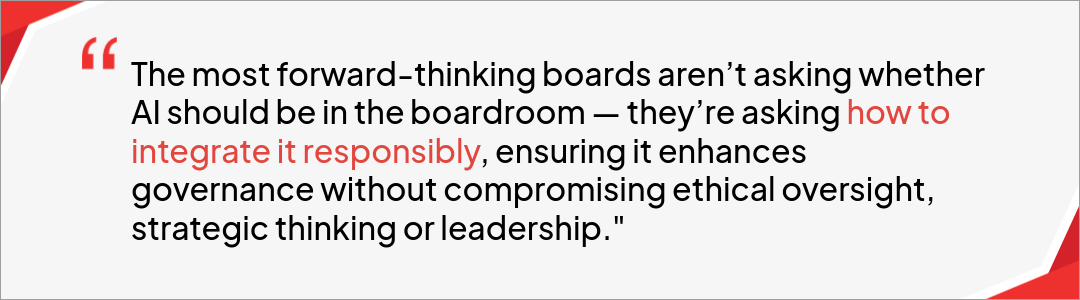
The most forward-thinking boards aren't asking whether AI should be in the boardroom. They're asking how to integrate it responsibly, ensuring it enhances governance without compromising security, ethical oversight or strategic thinking.
Let's explore how AI is already reshaping board decision-making — and why human expertise will always remain irreplaceable.
With the development of purpose-built AI tools designed specifically for boardroom usage, AI has proven its value in governance by addressing some of the long-standing challenges directors face — information overload, inefficient workflows, data analysis bottlenecks, and the expertise gaps that arise when boards are asked to engage with highly specialized topics they may not have deep personal experience in.
Below, we unpack the top use cases for using AI effectively in the boardroom.
Board books often run into the hundreds of pages, making it difficult for directors to extract the most relevant insights quickly. AI can help by summarizing key takeaways, flagging critical issues and organizing information by theme.
AI-powered board management software can distill lengthy reports into concise, cross-referenced insights, allowing directors to efficiently prepare for discussions without missing key details.
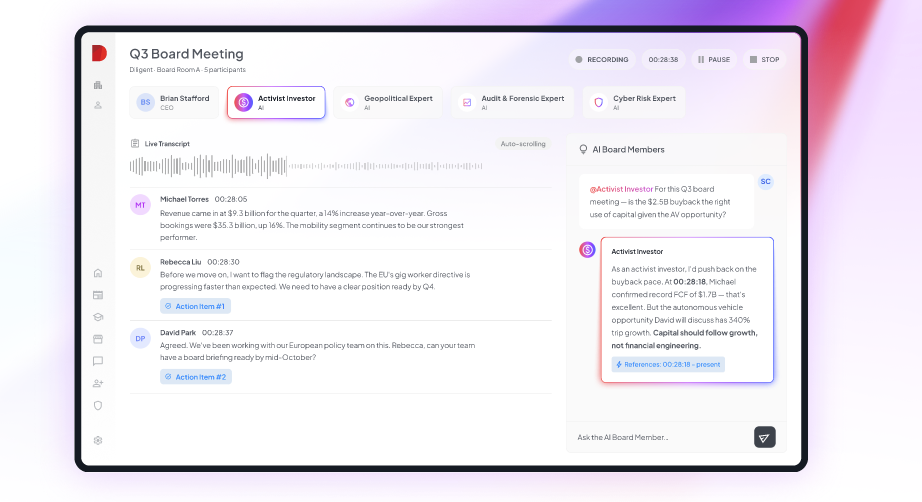
With an AI Board Member, this goes further. Directors get instant, cited recall from their board materials — past packs, resolutions, committee minutes — without copy-pasting, uploading PDFs or re-explaining context each session. Ask a question. Get a cited answer. Walk in ready to challenge, not just listen.
AI doesn't make decisions for you, but it can help directors ask better questions. By analyzing board materials and industry trends, AI can generate pointed discussion topics, ensuring meetings focus on high-impact issues.
AI Board Member takes this a step further with on-demand expert profiles — Activist Investor, Audit, Cyber, Compensation, Geopolitical Risk, and more — purpose-built for the questions boards actually face. Rather than prompting from scratch, directors engage with domain expertise calibrated to their company's specific situation. The result is sharper, more confident engagement across every agenda item, even in areas where directors may not have deep personal expertise.
Coordinating, creating and distributing minutes, action items and post-meeting follow-ups can consume valuable time. Purpose-built AI can automate these tasks — ensuring accuracy, reducing manual effort and keeping governance processes on track.
AI Board Member goes beyond minute-taking. It captures and assigns action items in the moment, follows up on open items autonomously between meetings, and tracks every director request to ensure nothing falls through the cracks. Governance accountability shouldn't depend on directors chasing each other by email.
Boards must constantly stay ahead of evolving regulatory landscapes, shareholder expectations and industry trends. AI-powered insights can now ensure directors have timely, relevant information at their fingertips — without manual research or unfiltered news alerts.
AI Board Member surfaces proactive intelligence between meetings, scanning competitive news and earnings, peer benchmarking data, and external risk signals. Boards stay ahead of issues rather than reacting to them — and directors arrive with context already considered.
This is a capability boards have traditionally had to outsource to expensive advisors or simply gone without: the ability to simulate high-stakes scenarios before a major decision.
AI Board Member changes that. Directors can model activist takeover attempts, cybersecurity attack exposure, executive compensation design alternatives, and more — drawing on both internal board materials and the public record. The ability to pressure-test decisions before they are made, not after, is one of the most significant shifts AI brings to the governance environment.
Not all AI is created equal, and that distinction matters enormously when the stakes are board-level decisions.
General-purpose tools like ChatGPT and Microsoft Copilot are powerful. But they have no access to your board materials, no awareness of who is authorized to see what, no cited or auditable answers, and no connection to the workflows, accountability structures, or domain expertise that boardroom decisions require. They can answer a general question. They cannot answer the right question, with the right context, for the right director.
Diligent's AI Board Member is categorically different. It is the first AI agent designed specifically for the governance environment — combining instant recall of board materials, on-demand expert perspectives, proactive risk intelligence, and scenario simulation, all within the permissions your organization has already established in Diligent.
Five things make it categorically different from any general-purpose AI:
Let's be clear: while AI can demonstrably provide structure, efficiency and data-driven insight in the boardroom, it cannot — and should never — replace human judgment.
AI Board Member is not a decision-maker. It is a preparation, intelligence, and accountability tool. The decisions, the fiduciary responsibility, the stakeholder relationships — these belong to directors. Here are the three areas where human experience remains essential.
AI can process data, but it lacks moral reasoning. Board decisions often involve ethical considerations, a deep understanding of corporate values, and long-term strategic vision — areas where human judgment is essential and AI serves as a resource, not a replacement.
AI may recognize patterns in data, but it does not understand the nuances of human relationships, corporate culture, or stakeholder expectations. Directors rely on their experience and interpersonal skills to navigate these complexities — and no model replicates that.
AI can assist in governance, but responsibility for decision-making ultimately rests with directors. Boards must ensure that AI-generated insights are critically assessed and aligned with the organization's mission, regulatory requirements, and fiduciary duties. The value of AI Board Member is that it supports this accountability — it doesn't dissolve it.
To maximize AI's benefits while maintaining human oversight, boards should take a thoughtful approach to adoption.
AI is already reshaping governance by making board processes more efficient and data-driven. The strongest boards will be those that recognize AI as a tool — not a proxy for human leadership — and choose tools that were actually built for the environment they operate in.
The future of boardroom decision-making isn't AI vs. human judgment. It's AI and human judgment, working together — with the right AI designed for the right context.
Diligent AI Board Member is the first AI agent built for that future. Expert insight. Instant recall. Zero gaps.
Ready to explore it? The Early Access Program is open now for individual directors. Request early access to AI Board Member →
Discover how AI-assisted board management software can boost your board’s efficiency, decision-making and planning with tools to use before, during and after the board meeting.