
In this article

Board directors spend 278 hours annually on board activities, a large portion of which is preparing for and attending meetings, according to the Spencer Stuart Director Pulse Survey. At that scale of investment, meeting quality stops being an administrative concern and becomes a strategic obligation. The board meeting rules an organization adopts, from notice periods to quorum to how votes are called, are what turn that time into decisions rather than discussion. Board meetings are crucial forums for strategic discussion, decision-making and governance. However, poorly planned meetings can be unproductive, disengaging, and ultimately hinder an organization’s progress. Leveraging board meeting best practices can keep your meetings on the right trajectory.
The gap is widely felt. According to the APAC Governance Outlook 2026 by Diligent Institute, the Governance Institute of Australia and the Singapore Institute of Directors, 63% of governance leaders believe boards should carve out more time for strategic discussions. Running effective board meetings is, for most boards, the single clearest route to closing that gap.
This article addresses some of the most common barriers to conducting effective board meetings and critical opportunities to oversee better meetings, including:
An effective board meeting is one that produces decisions the organization can act on, with every director able to exercise independent judgment. Effectiveness is measured by the quality of oversight a meeting enables, not by how smoothly it runs or how quickly it ends.
An effective board meeting drives decision-making, accountability and transparency. While boards should communicate between meetings, gathering in the boardroom allows for deeper discussions and more strategic decision-making about the organization’s urgent issues.
That capability rests on the relationship between the board and management as much as on process. "The board fundamentally has to trust management. There are lots of ways the board trusts but verifies. Trust starts with communication. Communication is successful when it’s proactive, when it anticipates and addresses board members’ concerns, and speaks to their experience from other boards and their operational experience," says Inna Barmash, Chief Legal Officer and Corporate Secretary at Amplify.
Research points the same way. Analysis published by the Harvard Law School Forum on Corporate Governance finds that directors who rate their own board highly also more often report that their chairperson overperforms, giving constructive feedback and facilitating productive discussions. Effectiveness follows board leadership quality, not just the agenda template.
When run according to board meeting best practices, board meetings become the backbone of board effectiveness. They create a space for meaningful discussions and debate, prompt the board to make necessary decisions and allow follow-up on anything previously decided. If you think of influential organizational changes, nearly all trace back to a board meeting.
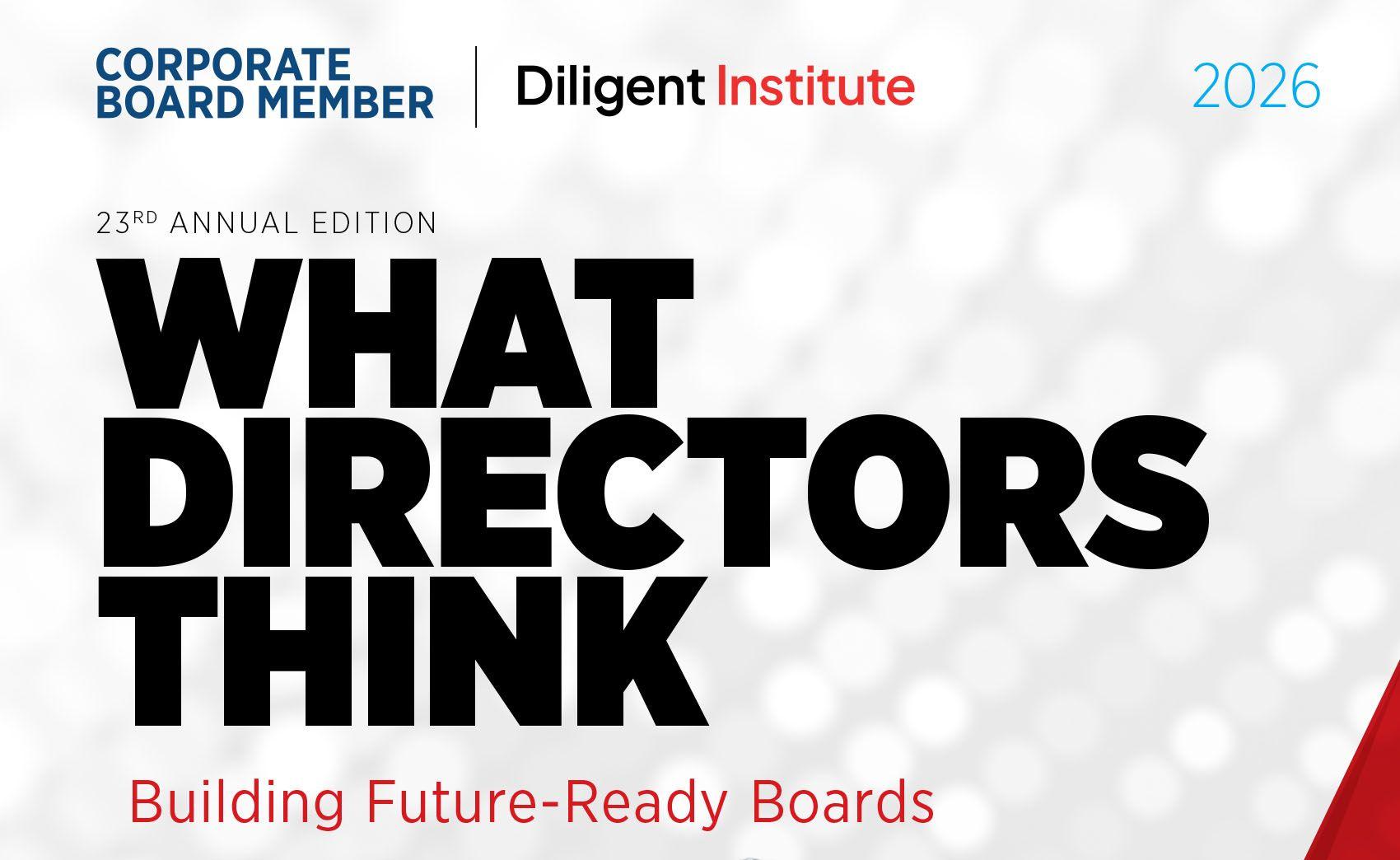
Where that is heading is a question Diligent Institute has tracked for more than two decades. "Looking ahead, high performing boards will treat governance as a continuous discipline, built on real time data flows rather than periodic reports. And they will increasingly rely on integrated digital platforms and, over time, AI-driven analytics to surface patterns, flag emerging risks and point directors to where their judgment is needed most, while keeping human decision-making firmly at the center," says Dottie Schindlinger, Executive Director of Diligent Institute, in What Directors Think 2026, the 23rd annual edition of the survey Diligent Institute publishes with Corporate Board Member.
Effective board meetings depend on five roles working to a clear division of labour: the chair leads, the corporate secretary documents, committee chairs report, the chief executive informs and directors challenge. Where those boundaries blur, meetings drift into updates rather than decisions.
In most organizations, the roles and responsibilities of the board of directors are well-defined and often detailed in the bylaws. However, well-run meetings demand slightly different roles for the board’s key players. These include:
These roles apply to the full board of a corporation. An executive board meeting, run by an executive or steering committee, follows a narrower remit and a different cadence.
See how high-performing boards structure discussion time so directors arrive ready to decide.

Board meeting procedures fall into three phases: setting objectives and distributing materials before the meeting, establishing quorum and managing motions during it, and recording and storing minutes afterwards. Effectiveness depends on all three, but the pre-meeting phase determines most of it.
Meetings can feel time-consuming, but many procedures begin before the meeting is even in session. Understanding the key board meeting procedures means looking closely at key activities before, during and after meetings.
Each of these steps has more depth to it than one section can carry. Our guidance on board meeting preparation covers the full pre-meeting sequence.
What happens in the room is shaped by what directors were given beforehand. According to What Directors Think 2026 by Diligent Institute and Corporate Board Member, 58% of directors want more time for strategic planning and 42% want fewer presentations and more discussion. Both are agenda design problems, not attention problems.
The practices below are grouped by what they improve: participation, decision quality and overall meeting effectiveness. Taken together they are the levers a chair and corporate secretary can pull to make board meetings more effective without changing the bylaws.
Numerous processes coalesce to make an effective board meeting. With the support of the corporate secretary, board chairs must cultivate several skill sets to engage the board in every meeting, including fostering engagement, driving decision-making and enhancing meetings’ overall effectiveness.
1. Start and end the meeting on time: Respecting the designated timeframe demonstrates efficiency and prevents fatigue, fostering a more focused and engaged environment.
2. Promote active discussion by employing diverse participation strategies: Go beyond traditional presentations and lectures. Encourage open dialogue by soliciting questions and feedback throughout the meeting. Utilize breakout sessions, brainstorming exercises, and role-playing scenarios to stimulate diverse perspectives and active participation.
3. Follow the agenda: While following the agenda sounds simple, meetings can quickly get off track. Board members may have issues on their minds, or planned discussions can take unexpected turns. Board chairs should anchor to the agenda and always redirect the meeting according to it. This respects board members’ time to review the agenda before the meeting and ensures all essential items are covered.
4. Use your time wisely: Keep meetings focused and efficient. Prioritizing mission-critical issues like strategic planning and minimizing time on routine efforts can make the most of the board’s time. Discussing key risks and opportunities will also engage board members more than updates you could communicate in writing outside of a meeting.
5. Ensure all voices are heard and respected: Create an inclusive setting where everyone feels comfortable sharing their opinions and asking questions. Acknowledge and address diverse viewpoints while maintaining respectful and productive discourse.
6. Delegate tasks and use individual expertise: Rotate who leads discussions on different agenda items, tapping into the board’s collective knowledge and experience. Assign specific tasks or questions to individual members, fostering ownership and engagement.
7. Create space for relationship-building: Board members spend hundreds of hours on board-related activities each year. Having strong relationships with each other can make the difference between being productive and wasteful. Create space for connection before or after meetings; stronger relationships can lead to more dynamic meetings.
8. Clearly define the meeting’s purpose: What is the meeting for? Board chairs and corporate secretaries should determine the primary objective of each meeting and share it with attendees. This can focus engagement and decision-making around the most mission-critical items on the agenda, helping the board focus on key decisions.
9. Provide clear and concise information relevant to the agenda: Discuss factual data and well-considered analysis. Avoid overloading the board with unnecessary details that could hinder clear decision-making.
10. Use context and data: Risks and opportunities don’t exist in a vacuum. Whether a board will opt to mitigate or embrace a risk has everything to do with the context surrounding that risk. Equip board members with relevant background information, reports and metrics to support more proactive, informed decision-making.
11. Encourage critical thinking and open debate: Create an environment where diverse perspectives are welcomed and openly discussed. Allow time for reasoned debate and exploring potential alternatives before reaching a decision.
12. Ensure voting processes are fair and transparent: Uphold established board meeting best practices, procedures and voting guidelines, ensuring all members understand the decision-making process.
13. Foster consensus, but know when it’s time to vote: Gaining the approval of all board members is ideal but not always realistic. While encouraging discussion toward consensus during the meeting matters, chairs shouldn’t let the group get stuck. Use motions and votes to move forward if the conversation becomes circular or if board members are unlikely to evolve their point of view.
14. Document decisions clearly: Assign a dedicated individual, often the corporate secretary, to take detailed minutes, accurately capturing all critical decisions, action items and next steps.
15. Distribute the agenda before the meeting: Reviewing the agenda at the start of each board meeting is a poor use of members’ valuable time. Sharing the agenda before the meeting gives attendees time to review each item and prepare their initial thoughts. This fuels meaningful discussions rather than wasting time waiting for each member to think through their point of view.
16. Seek feedback from board members and participants: After each meeting, gather feedback through surveys, anonymous polls or facilitated discussions. This feedback will help identify areas for improvement and ensure the board is meeting the needs of its members and the organization.
17. Follow through with accountability: Assign clear responsibilities and timelines to implement decisions. This creates an accountability paper trail, but board members can encourage each other’s follow-through. Without it, directors may struggle to mobilize on discussions or decisions, turning otherwise impactful meetings into wasted time.
18. Review and adapt meeting agendas and structures based on feedback: Be open to adjusting your approach based on ongoing feedback. Consider incorporating different formats, technology platforms or participation strategies to enhance the board’s effectiveness.
19. Regularly review and update relevant board meeting procedures and policies: Ensure that governance policies and board meeting best practices are current. Revisit and update these documents regularly to maintain optimal board performance and effectiveness.
20. Send detailed meeting follow-ups: The best meetings are packed with discussions, debate and decision-making, often accompanied by post-meeting tasks for each board member. Succinct but specific meeting-minute emails keep the contents of each meeting fresh and hold the board accountable for anything they agreed to.
See what 200+ public company directors told Diligent Institute about where board time should go.

Technology improves board meeting effectiveness when it removes preparation work that competes with oversight. The measure is not hours saved but whether directors arrive better briefed and leave having decided more.
Corporate secretaries and governance professionals can foster a culture of effective board meetings by following concrete board meeting best practices. The well-organized, engaging and productive meetings that result will help drive effective governance, strategic decision-making and, ultimately, the organization’s success.
However, best-practice board meeting procedures alone won’t transform disorganized meetings into decisive meetings of the minds. Agendas and board materials often take hundreds of hours to prepare. Meeting minutes are equally intricate, requiring specific protocols to support board effectiveness and comply with regulations.
That preparation burden has an oversight cost. According to the GC Risk Index 2026 by Diligent Institute, only 21% of senior legal leaders are very confident their board receives the right mix of information on risk. Time spent assembling materials is time not spent improving what those materials say.
Diligent Boards, part of the Diligent One Platform, is designed with board meeting best practices in mind. Boost the quality of your board meetings with:
Assore Holdings, a mining and resources group, shows what that shift looks like in practice. After moving its board workflows onto Diligent Boards, the most consequential change was not administrative: directors moved from simply vetoing resolutions to commenting on them, which changed the character of board decision-making. Up to 60% time saved in board meeting preparation is what created the room for it.
Hybrid meetings raise the bar again, because a director joining remotely has to be as well equipped as one in the room. Tools that support effective hybrid board meetings share the same digital board book across locations, give secure remote access to materials and keep voting and minute-taking in one record regardless of where each director sits. Diligent Boards is supported by an ISO/IEC 27001-aligned information security management system, which matters when board materials travel outside the boardroom.
Start transforming your meetings with Diligent Boards today.
The board chair or president is typically responsible for ensuring that board meeting procedures are followed. They guide the meeting according to the organization’s bylaws, governance policies and any adopted rules of order (such as Robert’s Rules). The executive director and board secretary also play key roles in supporting compliance, distributing materials and documenting proceedings accurately.
The typical order of a board meeting follows a structured agenda and includes:
This format may vary slightly based on the organization’s bylaws or rules of procedure.
Failure to follow proper board meeting procedures can lead to confusion, legal risks and governance issues. Decisions made without quorum, required notice or correct voting processes may be challenged or deemed invalid. To protect the organization and its directors, it’s important to adhere to established procedures and document all actions clearly.
No, not all boards are required to follow Robert’s Rules of Order, but many choose to adopt them, or a simplified version, as a standard for structured, fair and efficient meetings. Whether Robert’s Rules apply depends on the organization’s bylaws or governance policy. Boards should agree on and document their chosen rules of procedure.
Conflicts of interest should be disclosed as soon as they arise. The conflicted board member should recuse themselves from discussion and voting on the matter to maintain transparency and integrity. Proper documentation of the disclosure and recusal should be included in the meeting minutes, in line with the organization’s conflict of interest policy.
Board meeting minutes should be recorded by the board secretary or a designated individual during the meeting. Minutes must be factual and objective and include key decisions, motions, votes and assigned actions. Draft minutes are reviewed at the next meeting, where they may be amended and then formally approved by a vote, becoming the official record.
Board meeting materials should be sent at least five to seven days in advance to give members adequate time to review reports, proposals and the agenda. For more complex or strategic discussions, sending materials 10 to 14 days ahead can improve preparation and decision-making. Timely distribution supports transparency, efficiency and informed participation.
Ready to make your board meetings more effective? Book a demo to see Diligent Boards in action.