
From federal to state and local.
For more than a decade, FedRAMP has set the standard for securing cloud services used by the federal government. Now, state and local governments are following suit with GovRAMP — a framework modeled on FedRAMP that applies the same principles of standardized assessment, authorization, and continuous monitoring at the state and municipal level.
For technology providers, GovRAMP represents both a new requirement and a new opportunity.
State and local agencies handle sensitive data every day:
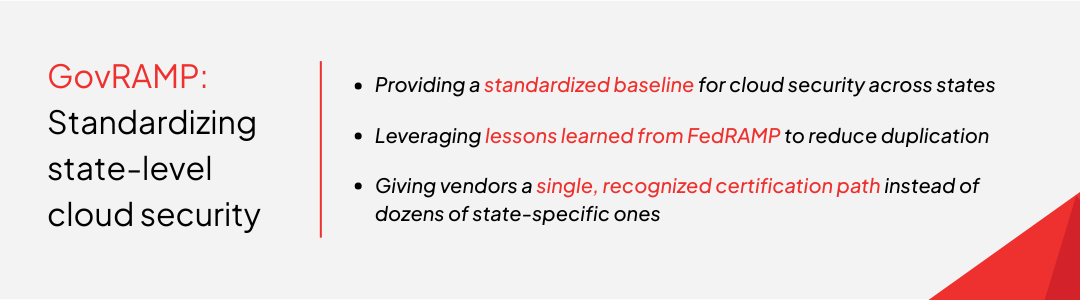
Until now, requirements for securing that data have been inconsistent. Some states built their own frameworks. Others borrowed pieces of federal standards. Many relied on vendor self-attestation. The result was a patchwork of expectations that slowed adoption and increased risk.
Real-world example: a health system vendor
Consider a SaaS provider that supports state Medicaid systems. In the past, every state customer might have asked for different evidence: one wants a SOC 2 report, another asks for NIST 800-53 mappings, another demands custom control attestations.
With GovRAMP, the vendor can pursue a single authorization that multiple states recognize. Instead of juggling different evidence packages and inconsistent audits, they point to one standardized certification. That reduces friction for the vendor — and provides greater assurance for every state agency.
For cloud providers already in the federal space, GovRAMP may feel familiar. The core principles are the same:
For vendors new to public sector markets, it’s a signal: the expectations you’ll face in selling to states will increasingly resemble the rigor of selling to federal agencies.
Here’s the good news: FedRAMP and GovRAMP are not competing frameworks. They’re aligned. If you already have a FedRAMP authorization, you’ve done the heavy lifting. In most cases, that FedRAMP package will satisfy or significantly accelerate GovRAMP requirements.
That means:
In short, FedRAMP isn’t just for federal. It’s becoming the de facto standard across all levels of government. Want to understand how FedRAMP is evolving? Explore what’s changing under FedRAMP 20x here.
Just like FedRAMP, GovRAMP requires continuous evidence collection, vulnerability management, and structured reporting. That creates the same challenges:
These challenges aren’t unique to GovRAMP. Defense contractors face similar hurdles under the newly finalized CMMC rule. A strong GRC platform isn’t just helpful — it’s essential. And because that platform itself contains sensitive compliance data, its own security posture matters. This is where FedRAMP-authorized platforms create a clear advantage: they meet federal standards that flow naturally into state requirements.
See how Diligent helps cloud providers meet public sector security standards with scalable solutions for monitoring and audit readiness.

Whether you’re already in the federal space or just exploring state and local markets, here are practical steps to prepare for GovRAMP:
GovRAMPisn’t just federal standards pushed downstream. It’s a recognition that state and local governments face the same threats and need the same assurance.
For vendors, that means two things:
Either way, GovRAMP is becoming the new baseline for doing business with public sector customers beyond the federal government. Vendors who prepare now will be positioned not only to win contracts, but to build trust with agencies looking for partners who take security seriously.
GovRAMP is expanding the reach of federal cloud security standards. Find out how Diligent helps vendors meet both FedRAMP and GovRAMP requirements with scalable, audit-ready compliance solutions here.
GovRAMP is a cloud security framework for state and local governments, modeled on FedRAMP. It sets consistent standards for assessing and authorizing cloud services — helping agencies protect sensitive data with confidence.
GovRAMP applies to state and local agencies, while FedRAMP is for federal. Both share core principles like standardized controls, independent assessment, and continuous monitoring — and they’re designed to work together.
GovRAMP is government-led and built on FedRAMP foundations. It was previously known as StateRAMP, but the organization rebranded to GovRAMP to reflect its expanded mission and stronger alignment with public sector cybersecurity needs. The legal entity remainsStateRAMP, but the operating name is now GovRAMP. You can read more in this recent announcement.
Vendors complete an independent assessment, meet baseline security controls, and implement continuous monitoring — similar to FedRAMP. If you’re already FedRAMP authorized, much of the work can carry over.
It reduces risk by creating a unified standard across states. That means fewer gaps, stronger protections, and easier verification of vendor compliance.
GovRAMP is gaining traction with state and municipal agencies — especially in sectors like health, justice, and finance, where data sensitivity is high.
Learn how Diligent helps vendors meet GovRAMP and FedRAMP requirements here.