

Policy and procedure management is the foundation that connects board-level governance with day-to-day operations. With hybrid work now firmly established and growing emphasis on ESG, DEI and AI governance — alongside constant regulatory and business change — effective policy management is more critical than ever.
Yet there's often a significant gap between board-level policymaking and organization-wide adoption. According to Diligent's Transaction Readiness Report, 60% of organizations report their governance and finance systems are either completely siloed or only partially integrated, with just 4% achieving full platform integration. This fragmentation extends to policy management, where well-crafted policies frequently end up in a virtual cupboard and are forgotten.
Boards face a fundamental challenge: How do you set strategic policy direction while ensuring those policies translate into consistent organizational behavior? The answer lies in establishing clear accountability, structured processes and technology-enabled oversight that bridges the gap between governance vision and operational reality.
This guide explains how boards can implement effective policy and procedure management by covering:
Policy and procedure management is the systematic process of creating, approving, communicating, maintaining and enforcing policies and procedures across an organization. It encompasses the full lifecycle from initial drafting through review, approval, distribution, attestation and eventual retirement.
Effective policy and procedure management connects board governance with operational execution. Your policies set out your corporate position, establishing your standpoint and supporting your goals and values. They provide the bridge between leadership vision and management tactics — aptly described as the "collective voice of the board."
To look at the importance of policy management, we need to consider the importance of policy over all.
Why is having policies important? Your business policies set out your corporate stall, establishing your standpoint and supporting your goals and values.
Your policies give your business operations a structure and framework that underpin your governance, risk and compliance programs. But of course, setting policy is only half the battle. Life would be easy if boards could set the organization on its chosen course and sit back to enjoy the ride.
In practice, there can be a chasm between board-level policymaking and business-wide adoption. The 2026 What Directors Think report — an annual survey of more than 200 U.S. public company directors conducted in partnership by the Diligent Institute and Corporate Board Member — shows this gap is widening. The findings reveal that 53% of directors say they don’t receive real‑time data between meetings, and 47% want more structured full‑board risk discussions — expectations that put even more pressure on having up‑to‑date, well‑documented policy frameworks. This is where policy management is vital.
Effective policy and procedure management follows a complete lifecycle:
Each stage requires clear accountability and documented processes. Organizations that skip stages, particularly attestation and regular review, discover gaps only during audits or crises, when remediation is most expensive.
Directors play a central role in determining policy, but should employ a lighter touch on implementation and oversight.
The board should determine company policies and delegate the implementation of those policies to management, confining the board's role to monitoring and evaluating this implementation. This sounds reasonable when you consider that delegating appropriate decision-making is recognized as one of the habits of highly effective boards.
Understanding when to step back is a skill all board directors should refine when it comes to policy. Your leadership team has been appointed for their collective expertise and judgment and should be allowed to exercise them.
Your policy statements should be broad yet concise, designed to outline your corporate purpose and position rather than providing step-by-step implementation actions. This approach enables the business to take ownership of policies, tailoring them to fit specific circumstances and updating them as needed in response to internal or external change.
Effective delegation doesn't mean disengagement. Boards retain crucial accountability in periodically reviewing and evaluating policies. The 2026 What Directors Think report found that 58% of directors want less time spent on presentations and more time for strategic planning — a clear signal that boards continue to prioritize forward-looking strategic discussions over operational detail, a finding that applies directly to policy oversight.
"There's often an inclination to avoid bad news, with a hope that problems will be resolved before they escalate to the board level," says Pav Gill, CEO of Confide. "But boards should proactively request access to whistleblowing reports. It's essential to see firsthand how secure, effective and current mechanisms are. Only then can you be confident in the integrity of your compliance framework."
While boards set direction, effective implementation requires coordinated involvement across multiple organizational functions. Large organizations increasingly establish cross-functional policy committees that handle lifecycle activities day-to-day. These committees typically include representatives from:
This structure ensures policies reflect operational reality while maintaining alignment with board-level governance direction.
What constitutes best practice in policy and procedure management? It encompasses several interconnected activities that transform policies from documents into organizational behavior.
When organizations start out, they often take a relaxed approach to documenting policies. A small number of employees and an entrepreneurial ethos can drive a reluctance to overly formalize procedures. As a business grows, though, documenting policies and processes becomes more critical.
Documenting your policies enables you to take a more consistent approach — especially if your organization consists of several locations or business entities — facilitating proactive risk management and giving boards comprehensive oversight of organizational operations and performance.
When you ask, 'How often should we review our corporate policies?' answers vary. But best practice is to review policies every one to two years — some experts suggest annually. And of course, if organizationally you have undertaken change, this will usually demand a change in your policies and procedures.
The most lovingly crafted policy is no good if the regulation it refers to was superseded years ago, or if legislation has been expanded since it was drafted, or if your business no longer resembles the organization described in the policy.
Maybe you have undergone corporate restructuring. You may have gone through a merger or divestiture or carried out an IPO. External events may have caused you to revisit your business continuity plans. All of these should trigger a review of your corporate policies.
Policy management is vital in itself, but from a board perspective, its importance in helping to create a risk-management-focused organization shouldn't be overlooked.
A best practice approach to policy management gives you a framework for your governance, risk and compliance strategy — enabling you to embed GRC at every level of your business. Having well-defined policies is a vital starting point for any programs designed to improve governance, risk or compliance. Policy management enables you to see where documented procedures are lacking and where your approach could be improved.
All change initiatives, including policy changes, come with execution risks. Whether you're undertaking an organizational restructuring, implementing new AI governance frameworks, or adapting to regulatory changes, any change to business policy and strategic management brings several risks that require careful management.
Not all changes are for good, and every policy tweak carries the chance that the new approach won't better the previous one. Boards need to communicate a sound rationale for change, underpinned by data that evidences the shortcomings of the outgoing policy.
Before approving significant policy changes, directors should ask:
Management must remain focused and positive (although realistic) about the project, particularly any slippages in timescales, to inspire commitment and buy-in. Resource constraints are real: according to Diligent's Transaction Readiness Report, 56% of organizations cite limited resources as their top challenge.
Boards can mitigate this by ensuring adequate resources are allocated for implementation, setting realistic timelines that account for operational demands, providing clear escalation paths when implementation encounters obstacles and monitoring progress without micromanaging execution.
Change is often met with skepticism, fear and resistance. Boards can help mitigate this by introducing policy change in small steps, rather than overhauling too much at once, and by leading by example in adopting new practices.
Turning reluctant employees into advocates of policy change demands clear communication and a pragmatic approach. Change should never be forced but should be bought into at all levels.
This requires clear explanation of why changes are necessary, involvement of affected teams in implementation planning, visible leadership commitment to new policies and recognition of early adopters and compliance champions.
Learn how automated policy management reduces compliance risk while freeing resources for strategic priorities.

For boards overseeing complex policy frameworks across multiple jurisdictions and business units, technology has become essential infrastructure rather than an optional enhancement. Centralized policy and procedure management platforms address the fragmentation challenges that undermine governance effectiveness.
Policy and procedure management software like Diligent Policy Manager provides configurable workflows that route policies through proper approval chains automatically. Rather than relying on email chains and manual tracking, policies move through creation, review and approval stages with full audit trails documenting who did what and when.
For enterprise organizations managing thousands of policies across global operations, these automated workflows ensure consistency while reducing administrative burden. Customizable workflows adapt to your organizational structure and approval requirements rather than forcing rigid processes.
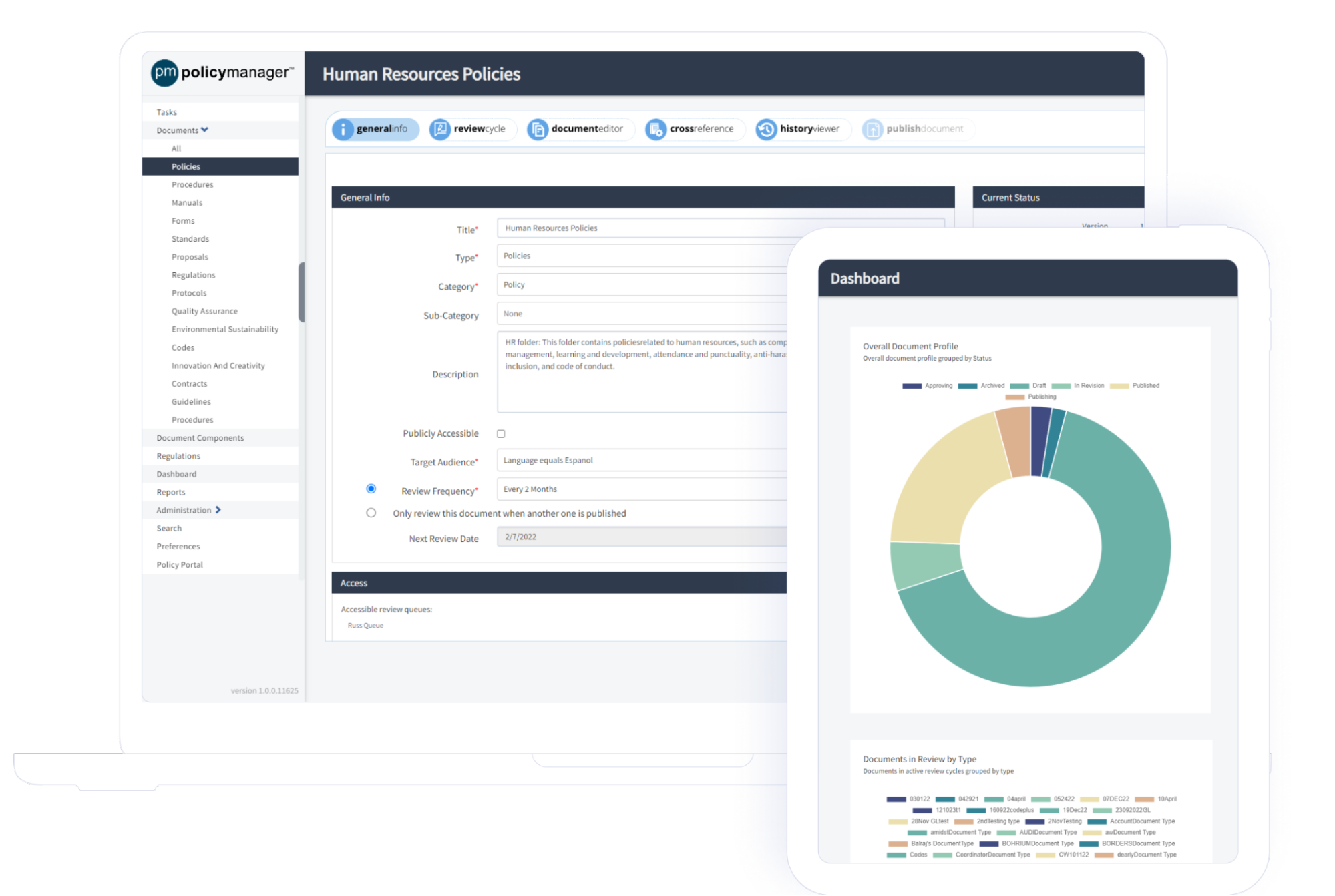
Automated attestations fundamentally change policy governance by providing documented evidence that employees acknowledged and understood their obligations. Policy Manager automatically tracks acknowledgment, delivers comprehension testing where appropriate and escalates incomplete attestations without manual follow-up.
This capability is particularly valuable during audit preparation and regulatory examinations. Instead of scrambling to compile evidence of policy compliance, organizations maintain continuously updated documentation that demonstrates governance maturity.
Policy changes create compliance risk when organizations cannot demonstrate which policies were in effect at specific times. Centralized policy management maintains a complete version history, approval tracking and audit trails that support regulatory compliance and litigation defense.
Advanced analytics transform this documentation into actionable intelligence. Organizations can demonstrate policy compliance metrics to investors and auditors while identifying departments or locations that require additional attention.
The most significant benefit of modern policy management platforms comes from integration with broader governance, risk and compliance systems. Policy Manager connects with the Diligent One Platform to ensure policy management aligns with risk assessments, compliance monitoring and board reporting.
Rather than managing policies in isolation, organizations connect policy frameworks to the risk and compliance activities they're designed to support.
Effective policy management requires boards to set strategic direction while allowing management to oversee implementation. Get this balance right, and you'll enjoy better documented processes while strengthening your entire GRC strategy.
See how Diligent delivers audit-ready policy management that scales with your organization. Request a demo to get started.
Best practice is to review policies at least every one to two years, with interim reviews triggered by material changes. These triggers include regulatory changes, corporate restructuring, M&A activity, IPO preparation, technology adoption and crisis events that expose policy gaps.
Policy and procedure management platforms automate review cycles and reminders, ensuring policies stay current without relying on manual tracking. This continuous approach prevents the common problem of discovering outdated policies only during audits or incidents.
The board determines strategic policy direction and maintains oversight responsibility, while management implements policies and monitors day-to-day compliance. This delegation reflects the principle that boards should focus on strategic governance rather than operational details.
Boards retain accountability for periodically reviewing policy effectiveness, ensuring adequate resources for implementation and receiving regular reports on compliance status. Many organizations establish cross-functional policy committees that handle lifecycle activities while reporting to board oversight.
Essential capabilities include centralized policy repositories, configurable approval workflows, automated attestation tracking, version control with audit trails and advanced analytics for compliance reporting.
Integration with broader GRC platforms is increasingly important, allowing policy management to connect with risk assessments, compliance monitoring and board reporting. Organizations should also evaluate ease of use, implementation timelines and vendor support when selecting platforms.
Documented, current policies demonstrate governance maturity to investors and acquirers during due diligence. Organizations with systematic policy management can respond to due diligence inquiries efficiently, while those with fragmented approaches discover gaps at the worst possible time.
According to Diligent's Transaction Readiness Report, companies that conduct regular due diligence reviews and maintain integrated governance systems are significantly better prepared for transactions. Policy management is a foundational element of this readiness.
Schedule a demo to see how Diligent Policy Manager delivers audit-ready policy management for your organization.