
There are 195 countries today, most of which have increasingly complex rules and regulations governing the entities that operate within them. Global entity management has reached a critical inflection point as regulatory enforcement intensifies and compliance costs escalate dramatically.
"Making sure that we're in compliance everywhere we do business is a challenge," says Liane Noureldin, Senior Corporate Paralegal at Fortive Corporation, an American industrial technology conglomerate with more than 300 global entities.
Fortive Corporation isn't alone. According to recent research from EY, 96% of companies face significant challenges in managing legal entities with their current systems. With merger and acquisition deal volumes declining by 17% while deal values generally increased in 2024-2025, enterprises are pursuing fewer but more important transactions that demand sophisticated entity management capabilities.
Here, we'll explain why the right technology unlocks simpler entity management, including:
Corporate expansion continues at scale globally, with leading corporations maintaining hundreds of thousands of subsidiaries across multiple jurisdictions.
While M&A deal volumes declined 9% in early 2025 compared to the prior year, total deal value reached $3.4 trillion in 2024 — demonstrating that enterprises are pursuing fewer but significantly larger and more strategic transactions that demand sophisticated entity management capabilities.
At the same time, managing those entities hasn’t become easier. As recently as 2019, many companies still relied on complex and customized spreadsheets to manage mission-critical processes — leaving companies like Fortive to share data over email or manually request key metrics from specific individuals.
“Generally, companies don’t have an entity management solution. It’s usually just one person managing it via Excel,” says Noureldin, a process Fortive was all too familiar with.
Though global entity management via complex and customized spreadsheets may have once been enough, today’s business landscape is growing more complicated. Global entities must contend with laws, regulations and tax codes that change frequently and vary according to the jurisdiction. Entities are also under intense public scrutiny related to data privacy, environmental, social and governance (ESG) issues, human capital, and more.
Giving these issues their due manually across entities and locations is fast becoming untenable — and a growing barrier to long-term success. This challenge has only intensified as three major regulatory shifts fundamentally altered global entity management requirements:
These regulatory developments demonstrate why manual entity management processes can no longer keep pace with compliance demands. Organizations managing entities across multiple jurisdictions need technology that automatically tracks regulatory changes and ensures consistent compliance without overwhelming legal teams.
Entity management is fraught with challenges, whether the corporation operates in one jurisdiction or a dozen. Yet, missteps in global entity management can lead to significant financial, operational and reputational risks due to the intricacies of working across distinct localities with different — yet equally strict — requirements for entities that operate there.
Manual global entity management introduces potentially costly risks related to:
“We have entities all over the world, and each country has its own regulations and reporting system,” Noureldin says, challenging Fortive to stay up-to-date. Different countries and regions have distinct compliance requirements, from the General Data Protection Regulation (GDPR) in Europe to the Foreign Corrupt Practices Act (FCPA) in the U.S. Manually managing those laws and regulations increases the chances that a corporation will miss an essential requirement.
A corporation’s tax burden can also vary from entity to entity. For instance, corporations in the UK are subject to taxes that are different from those in the U.S. That’s before you consider the different employment laws, payroll taxes and more. Ensuring each entity pays the appropriate taxes at the appropriate time can significantly strain audit and accounting teams managing global operations.
Manual data management can easily lead to different employees entering the same data multiple times across systems, increasing the likelihood of discrepancies. This repetition is also time-consuming and resource-intensive, making data management less efficient.
Manual updates are often disseminated slowly, especially among dispersed entities. This compromises the accuracy of financial and compliance reports and predisposes the board to base critical decisions on outdated information.
Manual processing introduces delays that affect entity-related transactions and decision-making timelines. Errors require extensive rework, adding costs to already expensive global entity management operations.
Rework isn’t the only consequence of human error. Inaccuracies in financial statements or compliance reports can lead to instances of noncompliance, resulting in costly financial penalties and legal fees. Significant compliance failures and inaccuracies can also be reputationally damaging; 50% of global M&A leaders Deloitte recently surveyed said poor entity management could cause a change in deal structure.
Streamline global entity operations with intelligent compliance automation and regulatory monitoring that reduces manual workload.

Excel remains the default tool for many legal teams managing corporate registers and subsidiary compliance, but as organizations expand across jurisdictions, its limitations become compliance liabilities. When subsidiary deadlines live in separate spreadsheets managed by different teams, no one can answer: What filings are due next month across all our entities?
According to Diligent Institute's 2026 What Directors Think report, 26 percent of directors cite financial reporting and audit requirements as demanding the greatest board attention this year.
Version control creates another vulnerability. When multiple people edit the same entity register, changes conflict. Someone updates director information in their local copy while another person modifies the same record differently. Which is accurate?
This is how compliance gaps emerge during due diligence reviews. Manual tracking also scales poorly across jurisdictions – Delaware annual reports, UK confirmation statements and Australian ASIC renewals all follow different calendars.
Automated entity management platforms solve these problems through centralized data and jurisdiction-specific compliance engines. Rather than maintaining multiple spreadsheet versions, teams work from a single source of truth.
Compliance calendars automatically generate based on each entity's jurisdiction, entity type and fiscal year. When regulations change, the platform updates requirements across all affected entities simultaneously.
Managing global entities is inherently intricate and complex, but it doesn’t have to be ridden with challenges and complications — no matter how many entities you manage. Entity management software is designed to overcome the numerous challenges of manual global entity management, enabling businesses to streamline operations, enhance accuracy, and ensure compliance across jurisdictions.
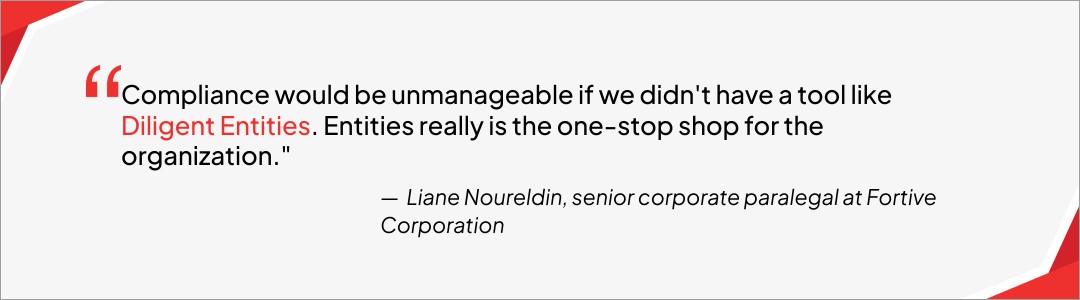
For example, Fortive uses entity management technology to capture data for its hundreds of legal entities in a centralized platform rather than collecting it via email or spreadsheets. Making this transition depends on comprehensive features that automate tasks and digitize records beyond what would be possible manually, including:
Together, these capabilities transform entity management from a fragmented, error-prone process into a streamlined operation that scales across jurisdictions.
Not all entity management platforms offer the same capabilities. Discover the 10 must-have features that distinguish leading solutions from basic tools.
Transitioning to global entity management software has more advantages than streamlining administrative tasks. It’s an investment in better decision-making, stronger operations and a more competitive entity that can securely and legally operate anywhere in the world.
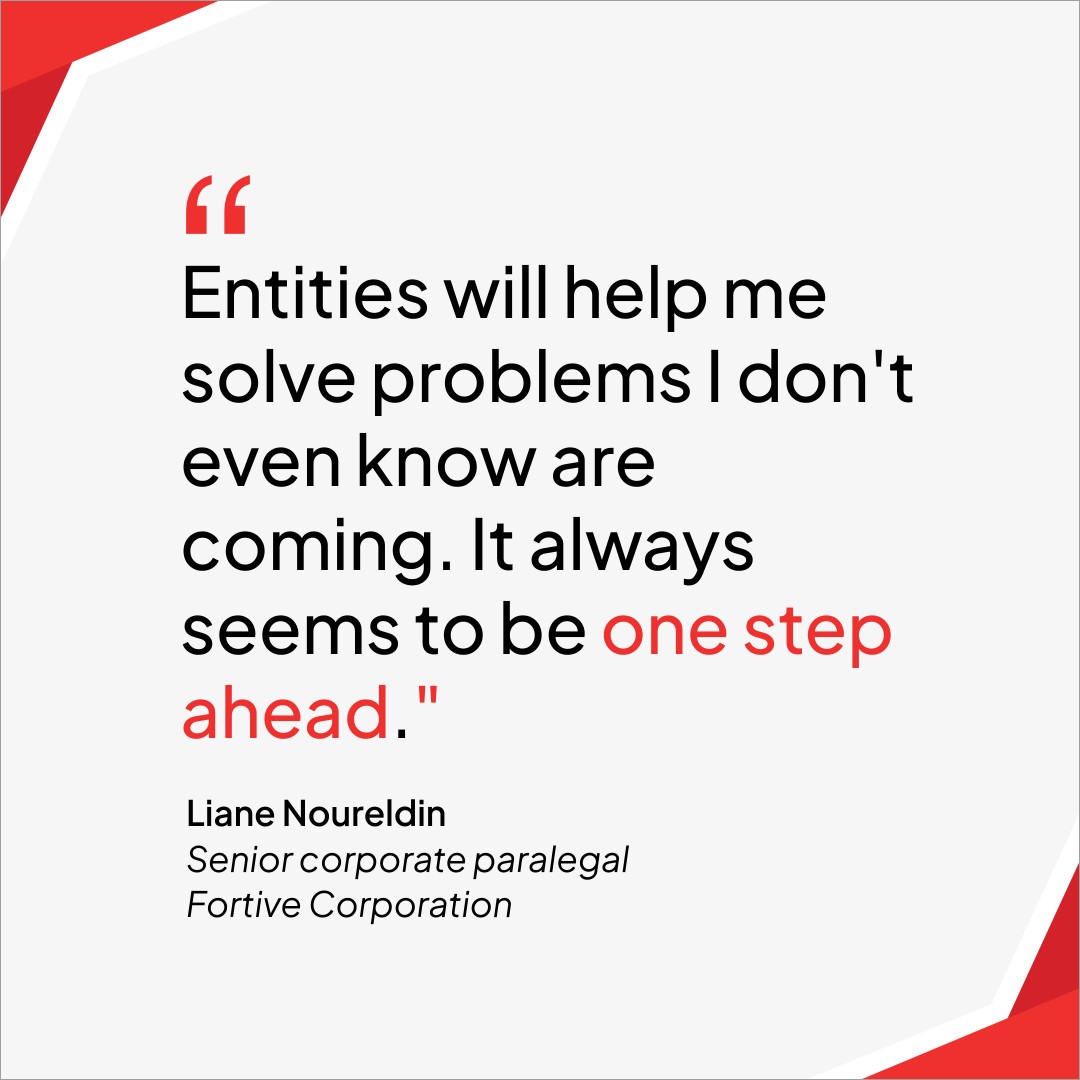
Though peace of mind can be hard to quantify, for Fortive, the difference is tangible.
“They get really excited to know they don’t have to email someone or chase someone down,” Noureldin says. “It’s there, and it’s accessible to everyone.”
When companies like Fortive adopt entity management software, they also:
These benefits compound as organizations grow. What starts as time savings for legal teams evolves into significant advantages: faster due diligence during transactions, confident board decision-making backed by accurate data and seamless expansion into new markets without compliance delays.
The global business landscape is fast-paced and ever more intricate. Yet, it’s also ripe with opportunities for entities that can successfully navigate the complexities of operating across jurisdictions. While traditional manual processes struggle to keep up, global entity management systems (GEMS), like Diligent Entities, excel at staying ahead.

Though Fortive found the right fit in Diligent Entities, buying an appropriate entity management solution for your organization is crucial. More entities than ever see the need for powerful software solutions, but don’t always know how to evaluate them.
The right platform should align with your organization's complexity: the number of entities you manage, the jurisdictions where you operate and the compliance requirements you face.
Technology that works for a corporation with 50 domestic entities may lack the capabilities needed for 300 global subsidiaries across multiple regulatory frameworks, while enterprise solutions might overwhelm organizations just starting to formalize entity management processes.
Download our entity management software evaluation framework to discover the essential elements your organization needs, what features should be nonnegotiable and much more.
Platforms must provide SOC 2 Type II compliance, ISO 27001 certification, and data residency options across multiple jurisdictions. Essential features include role-based access controls, immutable audit logging, and integration capabilities to meet security requirements for global operations.
Tracking compliance deadlines across multiple subsidiaries requires centralized visibility that spreadsheets can't reliably provide. Modern entity management platforms maintain jurisdiction-specific compliance calendars that automatically generate filing requirements based on each subsidiary's location, entity type and fiscal year.
The platform approach creates automated workflows where systems notify responsible team members when filing deadlines approach, whether for Delaware annual reports, UK confirmation statements or Australian ASIC renewals.
Dashboard views show upcoming deadlines across the entire entity portfolio, allowing legal teams to filter by jurisdiction, deadline date or filing type to prioritize work and allocate resources without manual calendar maintenance.
Dedicated entity management platforms provide the most comprehensive alternative to Excel-based corporate registers by maintaining complete audit trails showing who accessed or modified entity information and when, solving the version control problems that create compliance gaps.
Unlike spreadsheets with free-form cells that anyone can edit in any format, these platforms enforce consistent data entry where director information, share structures and filing histories follow standardized formats that support accurate reporting.
Cloud-based platforms enable secure access controls where different team members see only the entities relevant to their role while maintaining a single source of truth, preventing the conflicts that corrupt Excel files when multiple people update information simultaneously.
Automating entity compliance across jurisdictions requires platforms that maintain current regulatory requirements for each location where you operate, with built-in knowledge of filing requirements, deadlines and processes that eliminate manual research and tracking.
Automation works through jurisdiction-specific compliance engines: when you register a Delaware corporation, the system automatically generates annual report requirements based on Delaware's rules, while UK subsidiaries receive separate workflows for Companies House confirmation statements.
Advanced platforms connect to regulatory databases so when jurisdictions update filing requirements or deadlines, the system reflects those changes across all affected entities in your portfolio, preventing compliance gaps that emerge when regulations change between manual review cycles.
Platforms must provide API-first architecture with RESTful APIs, authentication integration supporting SAML 2.0 and OAuth 2.0, and data synchronization with ERP, HCM, financial, and GRC systems. Configurable data residency and cross-border transfer controls support complex international operations.
Enterprise-grade platforms provide comprehensive data export capabilities that ensure organizations maintain ownership of their entity information. This includes structured data exports in standardized formats, document libraries with original formatting preserved, and comprehensive audit trail exports for regulatory compliance.
Request a demo to see how Diligent Entities transforms global entity management for enterprise organizations.